
Background Information
APGAR score
APGAR score should be recorded routinely at 1 min and 5 min after birth
| Component | 0 points | 1 points | 2 points |
|---|---|---|---|
| Appearance | Blue / pale completely | Peripheral cyanosis only | Pink |
| Pulse (heart rate) | 0 | <100 | >100 |
| Grimace (reflex irritability) | No response to stimulation | Weak cry when stimulated | Strong cry when stimulated |
| Activity (tone) | Floppy | Some flexion | Active movement |
| Respiration | No breathing | Slow / irregular breathing | Strong cry |
NLS Guidelines
Key Concepts
Inflation vs Ventilation Breaths
| Inflation breaths |
|
| Ventilation breaths |
|
Most causes of cardiac arrest in newborns are respiratory problems, instead of cardiac problems. More emphasis is put on optimising ‘Breathing’, if not managed well, any subsequent interventions (including CPR) would be ineffective.
CPR in NLS
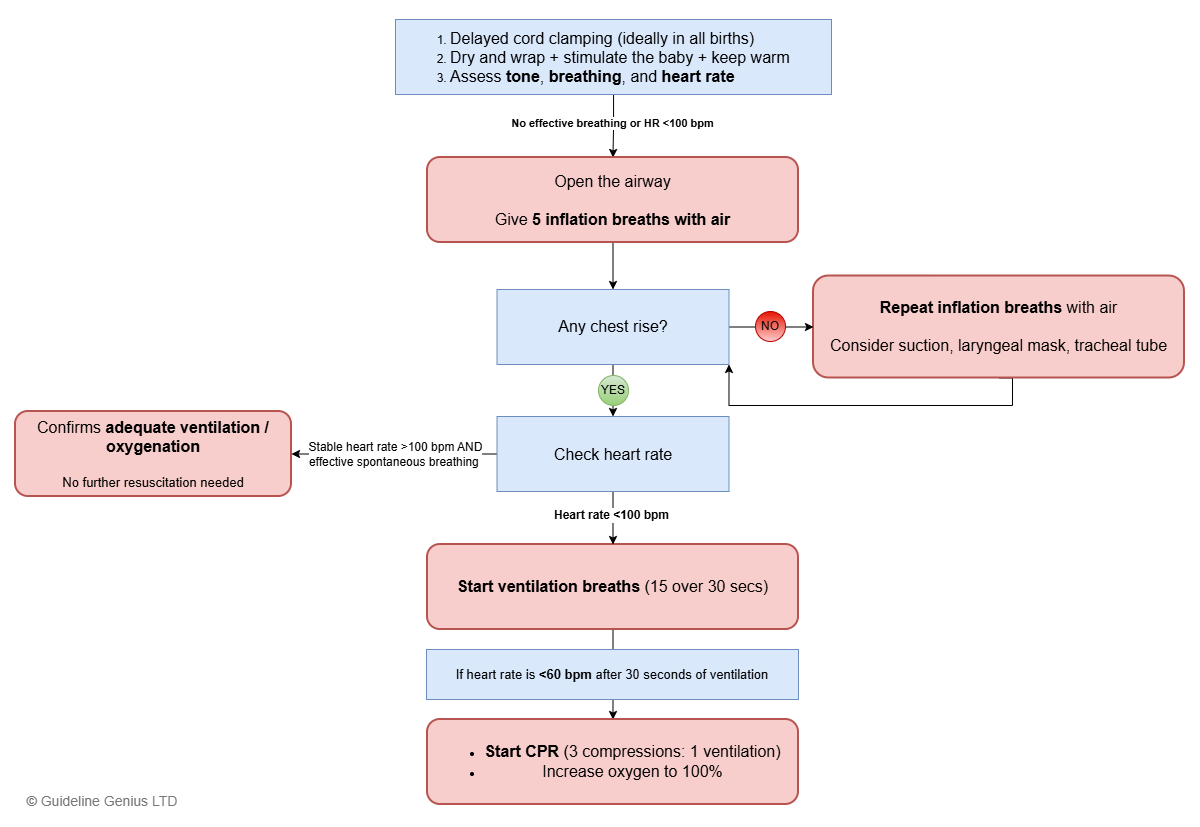
CPR (chest compression to ventilation ratio of 3:1) should only be started if the heart rate is <60 bpm after 30 seconds of good quality ventilation
Do not mix up the CPR ratios in various age groups:
- Neonates (0-28 days): 3:1
- Children (1 month – puberty): 15:2
- Adults: 30:2
Drugs in NLS
IV adrenaline (1:10,000) 0.2 mL/kg should be given after 30 seconds of effective ventilation and chest compressions
Other drugs to consider:
- Glucose – to reduce the likelihood of hypoglycaemia in prolonged resuscitation
- Isotonic crystalloid / O -ve blood – for suspected blood loss or shock unresponsive to other resuscitative measures
- Sodium bicarbonate – for prolonged unresponsive resuscitation with intracardiac acidosis
NLS Algorithm
Discontinuing Resuscitation
Discuss stopping resuscitation if there has been no response after 20 minutes and reversible causes have been excluded.